Letting God Look At You (Leviticus 24)

Sermons It Was Always About Grace LETTING GOD LOOK AT YOU
IT WAS ALWAYS ABOUT GRACE · WEEK 1 OF 6

Letting God Look at You

Leviticus 24 — and the signpost buried in the middle of the book everyone gives up on.
May 4, 2025 Leviticus 24 Pastor Tyler Allred 25 min
SERMON RECAP · ~5 MIN READ

Letting God Look at You

Leviticus 24 — and the signpost buried in the middle of the book everyone gives up on.

I got lost a lot as a kid. My dad once took me to Dodger Stadium when I was five — field-level seats, the works — and somehow, by the third inning, I had drifted up to the fifth deck, perfectly content. After that, my dad taught us his whistle. A sharp, unmistakable sound he could send across a campground or a stadium. I still remember a summer in the woods, just past our campsite, getting turned around. Panic starting to rise. And then his whistle cutting through the trees. A signpost. I knew which way home was.

Some signposts are sounds. Some are a slide show on a Sunday morning, reminding you what God has already done. And some, it turns out, are buried in the middle of Leviticus.

We're starting a new series called It Was Always About Grace. And I know — Leviticus is usually where Bible reading plans go to die. You ride Genesis on a wave of dreams and plagues, you survive Exodus, and then everything stops. Sacrifices. Rituals. Blood in places blood was not meant to be. So God plants a signpost — a picture image — right in the middle of the book.

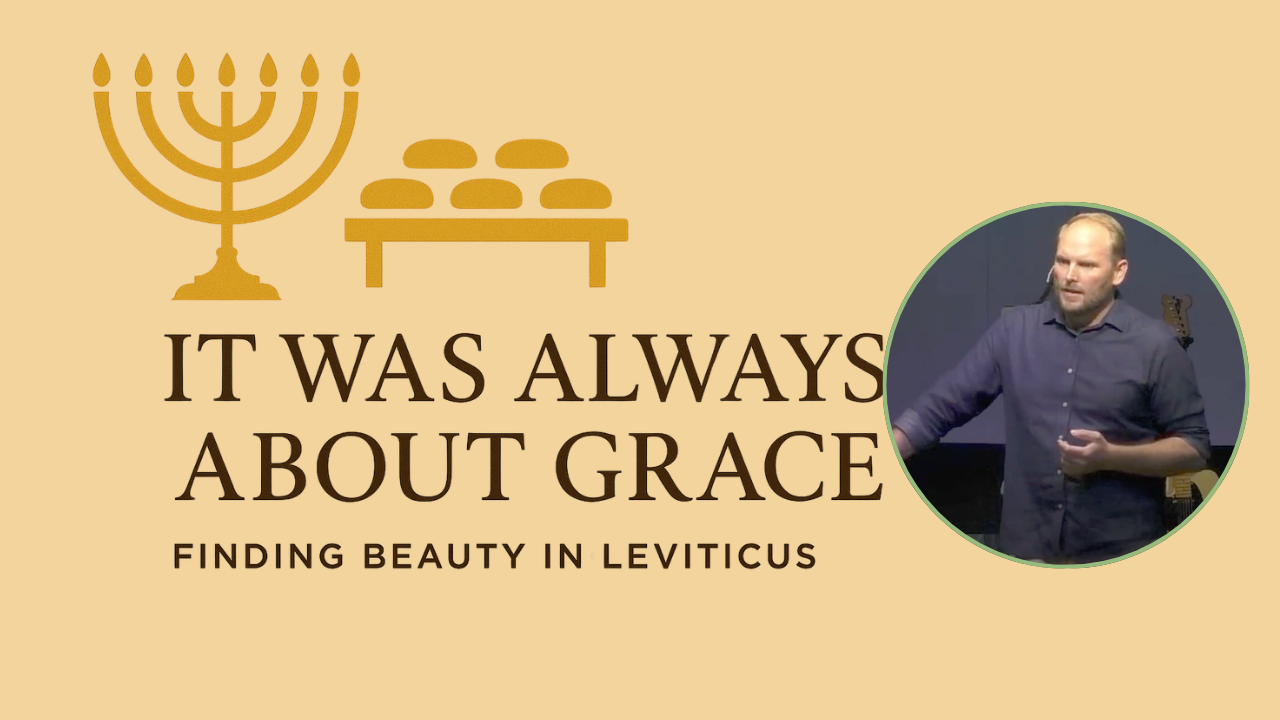
Leviticus 24 describes the heart of the tabernacle. The seven-pronged lampstand — the menorah — burns continually. Across from it, a table holds twelve loaves of bread. The priest's daily job is to trim the lamps so the light shines forward, onto the loaves. That's it. That's the picture at the center of Israel's worship.

The bread is the people of God — twelve loaves for twelve tribes. The light is God's presence. So the image is this: God places His people in front of Him, and He shines on them. Every single day. No hoops. No transactions. The whole thing is God saying, come sit in my presence, and let me look at you.

It matches a prayer from a couple chapters earlier — the High Priest's Blessing in Numbers 6. The Lord bless you and keep you. The Lord make His face to shine on you. The Lord lift up His countenance on you. Notice that's not Lord, give them what they want. It's may God lift up His gaze toward you. The blessing is just God looking at us.

That blew me up the first time I sat with it — because it's the exact opposite of every other ancient temple. In Mesopotamia and Greece and Rome, you went to look at the god. There was a statue of Dagon, or Marduk, or Zeus. You brought a sacrifice. You tried to manipulate. Religion was a vending machine: enough coins in, enough miracle out.

Israel turns it inside out. There's no statue, because we are the image of God. Genesis 1. The image was already in the room the moment you walked in. So in this temple, you don't go to look at God. You go so God can look at you.

"The blessing isn't a list of things God hands you. The blessing is God lifting His face toward you."

I think of us as angled mirrors — built to receive God's reflection and bounce it out into the world. The trouble is my mirror is cracked. Yours is too. The image we throw is fuzzy. The only way to get refinished isn't to white-knuckle our way to a better person — it's to walk into His presence and let Him look at us until the cracks start to soften.

In The Fellowship of the Ring, the company meets Galadriel and finds out very quickly that she is the one looking at them. Her gaze pulls every secret to the surface. Psalm 139 has the same charge — Lord, you have searched me, you know me, even before a word is on my tongue you know it completely. That can be the most comforting prayer in the Bible or the scariest, depending on what you've been hiding. Either way, the gaze is the point. He sees us. And He doesn't see us to shame us. He sees us to renew us.

So my invitation this week is small, and worth more than it sounds. Five minutes a day. Open the Bible. Play a worship song. Sit on the back porch. Pray one line: God, would you look at me? Let Him in. Let the cracks come up. Let Him do whatever quiet work He wants to do.

And if you're like me and you forget — put a signpost in your way. My family did this last month. We drove out to (yes, this exists in Morgan Hill) the rockery, picked out six river stones, and painted them as a family. They sit under the lemon tree by our front door now. On the hard days, those rocks remind me God's grace got me here. On the days I'm tempted to think it was all me, they remind me it wasn't.

A sticky note on the mirror. An alarm on the phone. A painted rock by the door. Whatever it takes. Just don't miss the invitation buried in the middle of Leviticus.

The lamp is lit. The bread is on the table. He's waiting to look at you.

Personal reflection on Leviticus 24 — for your time with the Lord this week. Find a quiet hour and a notebook.
1
THE WHISTLE
Tyler started with the memory of his dad's whistle cutting through the trees. Think back over the last year. What signpost — a sound, a song, a verse, a person — has God used to tell you which way home was? When was the last time you actually let yourself remember it?
2
THE LAMP ON THE BREAD
The whole image at the heart of the tabernacle is God shining on His people — no transactions, no hoops. Sit with that for a minute. What part of you still believes you have to earn God's attention? Where did that voice come from?
3
VENDING MACHINE
If you're being honest, what have you been quietly putting in the slot lately — what behavior, what religious effort, what good deed — hoping God will hand you something back? What would it look like to stop trying to manipulate Him this week?
4
WHAT THE GAZE TURNS UP
Read Psalm 139:1–6 slowly, out loud, in your room. Then ask: do these words land as comfort or as threat right now? Tell God why. Don't dress it up.
5
THE CRACKED MIRROR
If you're an angled mirror reflecting God to the people around you, where is your reflection most fuzzy this season? Name the relationship, the habit, or the thought pattern you'd most want refinished. Bring it to His light.
6
FIVE MINUTES
Pick a five-minute window each day this week — same time, same chair if you can. Open the Bible, play a worship song, or just be quiet. Pray one line: God, would you look at me? Then stop talking. What did you notice on day one? Day three? Day seven?
7
THIS WEEK'S INVITATION
Put a signpost in your way. A sticky note on your bathroom mirror. An alarm on your phone. A painted rock by the door. Something tangible enough to interrupt your day and aim you back at the lamp. What will yours be — and where will you put it?
For Sunday night small groups and weekday studies — questions to take this further together. Plan for ~45 minutes of discussion.
1
OPEN
Tell the group about a time you were lost as a kid — physically, emotionally, in a store, in the woods, anywhere. Who or what finally helped you find your way back? What did that "signpost" feel like in the moment?
2
READ TOGETHER
Read Leviticus 24:1–9 aloud as a group. Then read Numbers 6:22–27. What do you notice when you put those two passages side-by-side? What stands out about the picture God is painting?
3
THE LAMP ON THE BREAD
In the heart of the tabernacle, God places His people in front of Him and shines on them — every day. No sacrifices in this scene. No transactions. Why do you think God leads with this picture, before all the rules and rituals around it? What is it meant to teach the people who get lost in the details?
4
VENDING MACHINE GODS
Tyler contrasted Israel's worship with the pagan temples — where you went to look at a statue and try to manipulate the god into giving you what you wanted. Where do you see that "vending machine" instinct still alive in modern Christianity? In your own prayer life? Be specific.
5
YOU ARE THE IMAGE
Genesis 1 says we are the image of God — the only image He permits in His creation. If we took that seriously, how would it change the way we walk into a sanctuary? The way we look at the person across the table? The way we look in the mirror?
6
COMFORT OR THREAT
Read Psalm 139:1–12 out loud as a group. Tyler said this psalm can be the most comforting prayer in the Bible or the scariest, depending on what you've been hiding. Where in your life do those verses comfort you? Where do they make you uncomfortable? What might God be doing in that discomfort?
7
SIGNPOSTS
Tyler talked about painted river stones his family put under their lemon tree, and offered other simple ideas — sticky notes, phone alarms, art on a wall. What signposts have actually worked in your life to keep you oriented to God? What's gone stale, and why?
8
TAKE IT OUT THE DOOR
Each member commits to two things this week: (1) five minutes a day, just sitting in God's presence with the prayer God, would you look at me?, and (2) one tangible signpost placed somewhere they'll see it daily. Share what yours will be. Plan to report back next time.
PDF
Study Notes — printable PDF
Solo + group questions formatted for small groups. 2 pages.
Download →
Previous
Previous

God Makes The First Move (Leviticus 1)

Next
Next

Lift up your eyes (Psalm 121)