The Art of Loving Our Neighbor

Sermons It Was Always About Grace The Art of Loving Our Neighbor
IT WAS ALWAYS ABOUT GRACE · WEEK 6 OF 6

The Art of Loving Our Neighbor

The two greatest commandments, and the verse Jesus said unlocks the whole Bible.
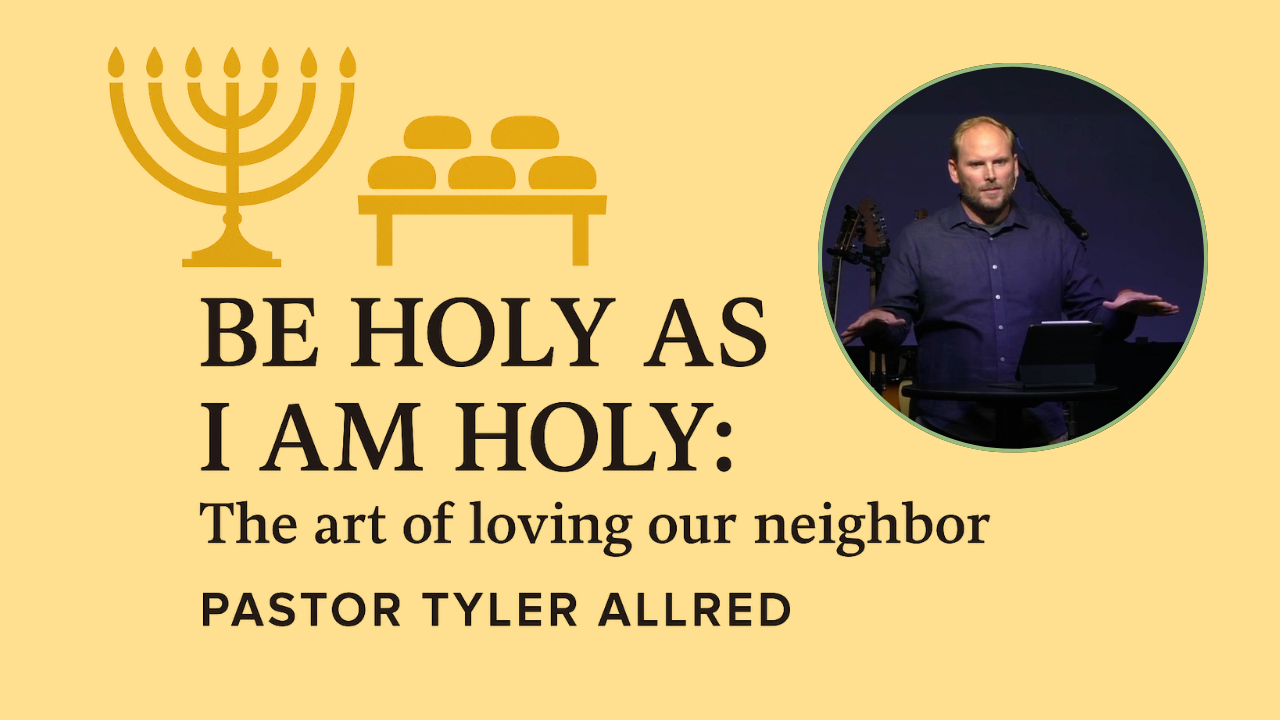
June 8, 2025 Leviticus 19 Pastor Tyler Allred 26 min
SERMON RECAP · ~5 MIN READ

The Art of Loving Our Neighbor

Leviticus 19, the two greatest commandments, and the verse Jesus said unlocks the whole Bible.

I've fallen down a YouTube rabbit hole lately — long-form debates between prominent atheists and Christians. And one thing keeps jumping out at me: morality is the hardest spot to defend on the atheist side. Where do our ethics actually come from? Why do we sense — almost instinctively — that some things are right and some things are wrong?

C.S. Lewis argues in Mere Christianity that the natural moral law, visible across cultures, points us toward a Lawgiver. Tom Holland — the historian, not Spider-Man — argues in Dominion that the water Western culture swims in (care for the poor, the dignity of every human, hospitals, schools, the impulse toward justice itself) traces all the way back to Jesus. And then I turn to Leviticus 19, and I realize God was making the same argument three thousand years earlier.

Leviticus 19 walks through every dimension of life — family, worship, the courtroom, the harvest, business, the way you speak about a neighbor when they aren't in the room. And after almost every command, God gives the same reason: I am the Lord. That phrase repeats fifteen times in one chapter. It isn't "because it's efficient" or "because the social contract requires it." The rule is His character. He is the reason.

It's the finale of It Was Always About Grace, and it bookends where we started. Way back in week one we said the whole point of being God's people is to reflect His image — like a mirror tilted at forty-five degrees, receiving God's likeness and reflecting it out to everyone we meet. Worship is the room where He smooths the cracks and wipes the smudges. Leviticus 19 is where that smudge-free mirror walks back into Monday morning. This is where the rubber meets the road.

The chapter opens with one of the great hinges in Leviticus: "You must be holy, because I, the Lord your God, am holy." It's the first time God hands the language of holiness to the whole community — not just the priests at the altar but every member of His people. And the wild thing is, He doesn't follow it up with "now go live on a mountaintop." He follows it up with how to harvest your field, how to honor your parents, how to keep your books, how to speak in court. Holiness here isn't separation from the world. It's fully integrated, with a different animating force underneath.

Jesus picks up Leviticus 19 again in Matthew 22. An expert in the law asks Him for the greatest commandment, and Jesus answers with two — Deuteronomy 6 (love God) and Leviticus 19 (love your neighbor as yourself). Then He says on these two commands hang all the law and the prophets. These two verses unlock the whole Bible. Vertical and horizontal. Us and God. Us and everybody else. We are meant to live in the tension between them.

Then the chapter does something strange. Verse 17: do not hate your neighbor in your heart — rebuke them strongly. What does don't hate have to do with rebuke? It took me a long time to see it. The only people I'm ever willing to rebuke are the people I actually love. With my kids, we call things out all the time — because we are invested in who they're becoming. The annoying coworker I won't call out? That isn't love. That's apathy with a polite face.

"Apathy and indifference are a form of hatred. We live in a 'mind your own business' culture — and Leviticus 19 quietly asks us to mind one another's."

This might be one of the most counter-cultural verses in the book. Our culture's prevailing wisdom is mind your own business, don't meddle. Leviticus 19 says — politely — mind one another's business. Be so invested in your people that you would actually say something when a friend is headed for the cliff. Our family has lived in Morgan Hill for seven years, and we've been blessed with a circle of families whose kids have grown up alongside ours. We trust each other enough that one parent can step in and call all the kids back, and then the next parent takes a turn. That's a small picture of what God is after at the church scale.

Verse 18 lands the plane: do not take revenge, do not hold a grudge — instead, love your neighbor as yourself. Years back I was a Starbucks barista, and there was a guy on the crew who never covered anyone's shift but always asked for his to be covered. Three options every time he asked. I could take revenge — "no, I'm not covering you." I could hold a grudge — say yes, but quietly congratulate myself for being the bigger person. Or I could forgive whatever was past and love him. Love was always the harder choice and always the better one. We get a version of that Starbucks moment a hundred times a week — at the office, in our marriages, in the school pickup line. Three options. One leads home.

And if you read that whole list — the business, the family, the harvest, the court — and your gut tightens because you aren't measuring up, please don't hear God saying muster it up, get your act together. Hear what He's actually saying. Be holy, because I am holy is not a command. It is an invitation. Because I am holy, come into my presence and let me make you holy. Let me smooth the cracks. Let me wipe the smudges. Then walk back out and reflect me into the world.

Same grace from the very first chapter of Leviticus to the very last. And the rest of the road is just learning how to love our neighbor — one apathy at a time, one grudge at a time, one Starbucks shift at a time.

Personal reflection on Leviticus 19 — for your time with the Lord this week. Find a quiet hour and a notebook. Read the chapter slowly before you begin.
1
WHERE DO YOUR ETHICS COME FROM?
Tyler watched online debates and noticed how hard it is to justify morality without a Lawgiver in the picture. Sit with the question for yourself: when you sense that something is right or wrong, where do you actually root that conviction? Where in your week have you been borrowing Christian ethics without naming the God who underwrites them?
2
I AM THE LORD
Fifteen times in Leviticus 19, God's reason is simply I am the Lord. Read the chapter aloud and notice every time the phrase appears. Then ask: what reason am I giving for my own behavior right now? Convenience? Approval? Habit? What would shift if His character became the reason underneath the rule?
3
THE FORTY-FIVE DEGREE MIRROR
From week one of the series — we are mirrors tilted at forty-five degrees, designed to receive God's likeness and reflect it out into the world. Where in your life are you actually catching His light and reflecting it? Where has the glass gone smudged? Be specific. Don't tidy the answer.
4
SOLO OR INSTITUTIONAL?
Tyler named two ditches: the solo Christian whose Jesus quietly becomes an imaginary friend, and the institutional Christian who loves the programs but doesn't really know the living God. Which ditch is closer to you right now? What single step pulls you back toward the road between them?
5
APATHY IS HATE
"The only people I am ever willing to rebuke are the people I actually love." Who in your life are you not rebuking — not because you love them too much, but because you don't care enough? Coworker, neighbor, relative, friend. Name them. Ask the Lord whether He is inviting you back into their life.
6
REVENGE, GRUDGE, OR LOVE
Tyler's Starbucks moment: the coworker who never covered anyone's shift. Three options every time he asked — revenge, grudge, or love. Write down the most recent "Starbucks moment" in your week. Which of the three did you actually choose? What would love have looked like on the ground?
7
THIS WEEK'S INVITATION
Read Leviticus 19 slowly one more time. Pick the single area on the list — family, work, money, speech, mercy to the poor, an old grudge — where your gut tightens. Don't try to muster it up. Bring it into His presence first. Sit with Him for ten minutes. Then take one small obedience step into that area this week. Be holy because He is holy — not a command, an invitation.
For Sunday night small groups and weekday studies — questions to take this further together. Plan for ~45 minutes of discussion. Open with prayer; close with one concrete commitment.
1
OPEN
Share a moment from this past week when somebody in your life actually loved you well — covered a shift, made the meal, said the hard thing, just showed up. What did it form in you? What would have happened if they had chosen apathy instead?
2
READ TOGETHER
Read Leviticus 19:1–2 and 19:9–18 aloud. Then read Matthew 22:34–40. Notice the phrase I am the Lord as you go. What jumps out about how God grounds the whole list of commands? What does it mean that Jesus pulls Leviticus 19 alongside Deuteronomy 6 as the greatest commandments?
3
WHERE DO ETHICS COME FROM?
Tyler walked through C.S. Lewis (Mere Christianity) and Tom Holland (Dominion) — the natural moral law points to a Lawgiver, and the ethics our culture takes for granted trace back to Jesus. Where do you see our culture borrowing Christian ethics while denying the source? How does that show up in your own conversations at work or school?
4
SOLO CHRISTIAN / INSTITUTIONAL CHRISTIAN
Tyler told two stories — the friend who reads his Bible and skips church, and the college student who is at church four nights a week but doesn't really know God. Both are ditches. Which one is more common in our community? Which one is the bigger pull in your own life right now? How does this group help you live in the tension between them?
5
APATHY IS HATE
Tyler said the surprising thing: apathy and indifference are a form of hatred, because the only people we rebuke are the people we love. Does that ring true to you? Where have you experienced it on either side — somebody who cared enough to call you out, or somebody whose silence was its own kind of dismissal?
6
MIND ONE ANOTHER'S BUSINESS
"Mind your own business" is one of the loudest rules in our culture. Leviticus 19 quietly asks us to mind one another's. What would it look like for this group to be the kind of community where we actually call each other out — gently, in love, grounded in truth? What would you need from each other to make that safe?
7
REVENGE, GRUDGE, OR LOVE
Tyler's Starbucks barista story — three options every time the freeloading coworker asked. Take revenge, hold a grudge, or love. Pick a real recent moment from your week (work, family, marriage, friendship) and walk the group through what your three options looked like. Which did you choose? Which would have led home?
8
TAKE IT OUT THE DOOR
Each person, one commitment: name one neighbor — literal or metaphorical — you want to love better this week, and one specific way you will do it. Maybe it's a rebuke held back in love, a grudge laid down, a shift covered, an apology made. Don't try to muster holiness on your way out the door. Bring the person to God in prayer first. Then go love them. Come back next week and tell the group what happened.
PDF
Study Notes — printable PDF
Solo + group questions formatted for small groups. 2 pages.
Download →
Previous
Previous

Beyond Awe

Next
Next

Day of Atonement: The Sin Keeps Coming Back